Michelangelo and the Ceiling
Ticket or guided tour?There is no separate ticket for the Sistine Chapel: it is the last room of the Vatican Museums, and every ticket to the museums includes it. What you choose is a timed entry slot on your own, or a guide who walks you through the galleries and explains the ceiling before you go in, where talking is not allowed.
Compare the optionsWhy he did not want the job
In 1505 Julius II had commissioned Michelangelo to make his tomb, a sculptural project on a huge scale, which is the work he wanted. The ceiling was discussed in 1506 and the contract signed on 8 May 1508. He had little experience of fresco, and he never stopped thinking of himself as a sculptor. Around 1509 he wrote a comic sonnet to his friend Giovanni da Pistoia about the job: a goitre, his beard pointing at the sky, paint dripping on his face, his spine bent like a bow. It ends with a line I love for its sulk: “I am not a painter.”
Was the pope angry with him?
Often, and the feeling was mutual. They quarrelled over the tomb, and on 17 April 1506 Michelangelo left Rome secretly for Florence. He came back only under pressure, and the two were reconciled in Bologna. Stories of Julius hitting him with a stick come from his early biographers, Condivi and Vasari, and are anecdotes, not documented events.
There is also the story that Bramante pushed the ceiling on him hoping he would fail. That is Michelangelo’s own version: in a letter of 1542 he blamed his troubles on the envy of Bramante and Raphael, and Condivi repeats it. Nothing independent confirms it, and a letter of 1506 from the builder Piero Rosselli suggests Bramante actually doubted Michelangelo would take the job on. Treat it as his side of the story.
How he painted it
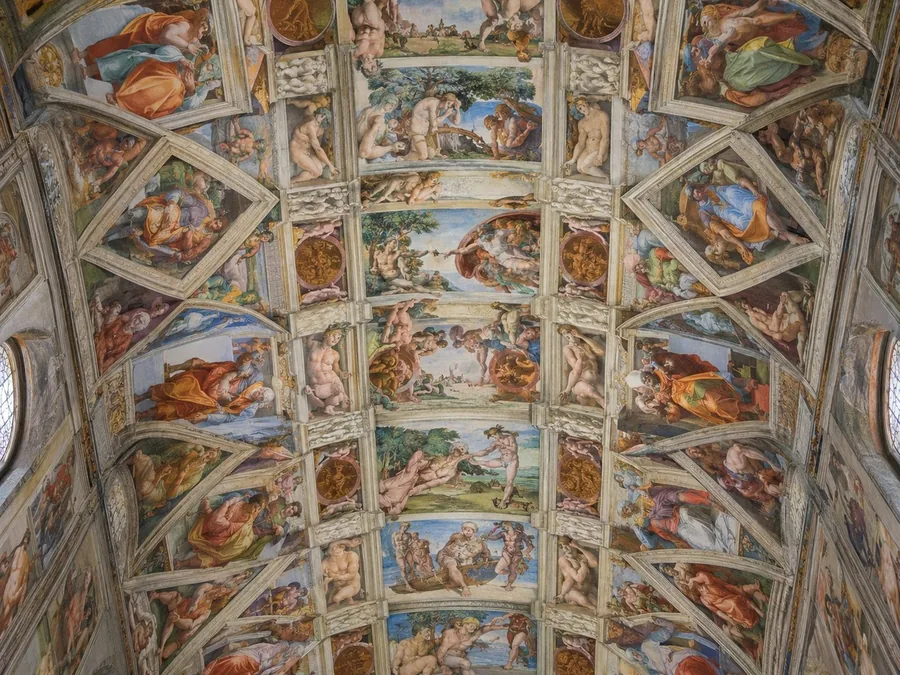
Bramante proposed a scaffold hung from ropes through holes in the vault. Michelangelo rejected it and had a wooden bridge built across the chapel, anchored in sockets in the walls near the windows. He painted standing on it, with his head bent backwards, exactly as the sonnet describes. The picture of him lying on his back comes largely from the 1965 film The Agony and the Ecstasy. He did not work entirely alone either: he had help with plaster and preparation, and at first a few painters from Florence, most of whom he soon sent away. The figures are his.
The first half was unveiled in August 1511, and the whole was finished in October 1512 and shown at the end of that month. Payment was 3,000 ducats. I would not try to turn that into modern money; the comparison does not survive five centuries.
How old was he?
Michelangelo was born on 6 March 1475, so he was 33 when he started the ceiling and 37 when he finished. He came back to the chapel in his sixties for the Last Judgment on the altar wall, painted for Paul III from 1536 to 1541, starting at 61 and finishing at 66. What to look for in both is on what to look for inside.
Was he sentenced to death?
Yes, in a sense, but not for painting nudes, and not in Rome. Michelangelo backed the Florentine Republic against the Medici and supervised the city’s fortifications in 1528 and 1529. After Florence surrendered in August 1530 and the Medici came back, Medici authorities ordered his death. He hid for about two months in a small room under the New Sacristy at San Lorenzo, and then Pope Clement VII, himself a Medici, pardoned him so that he could finish the Medici Chapel. The room was found in 1975 and opened to small numbers of visitors on 15 November 2023; whether the charcoal drawings on its walls are his is still debated. The nudity quarrel came a decade later, over the Last Judgment.
What disability did he have?
Here the honest answer is that we do not know, and much of what is written is guesswork. What is documented comes from Michelangelo himself: the strain of painting the vault, the goitre he describes in the sonnet (its medical meaning is debated), kidney stones and urinary complaints in old age, and sore, stiff hands late in life. A 2016 paper proposed osteoarthritis of the hands, based on portraits and letters, which is a retrospective diagnosis. Autism and depression have also been suggested in papers and books; none of that is established. There is no evidence that the ceiling blinded or crippled him, although Vasari relays that for a while he had to hold letters overhead to read them.
Before you go, read the sonnet to Giovanni da Pistoia. It is short and funny, and you will look at the ceiling differently knowing the man who painted it was complaining the whole time.
The history of the whole room, from Sixtus IV to the 2025 conclave, is on a short history of the chapel. A guide can tell you most of this in the galleries, before you reach the room where nobody may speak.
Frequently asked questions
Why did Michelangelo not like painting the Sistine Chapel?
He considered himself a sculptor, had little experience of fresco and was taken off Julius II’s tomb to do it. His own sonnet complains of a goitre, a bent back and paint on his face, and ends “I am not a painter”.
Why was the pope mad at Michelangelo?
He and Julius II quarrelled over the tomb, and in April 1506 Michelangelo left Rome secretly for Florence. They were reconciled in Bologna. Stories of beatings come from early biographers and are anecdotal.
How much was Michelangelo paid for the Sistine Chapel?
3,000 ducats for the ceiling. Converting that into modern money gives misleading results, so I leave it in ducats.
How old was Michelangelo when he painted the Sistine Chapel?
33 when he started the ceiling in 1508 and 37 when he finished in 1512. He painted the Last Judgment from 61 to 66. The dates are on the history page.
Was Michelangelo sentenced to death?
In 1530, after Florence fell, Medici authorities ordered his death for his part in defending the Republic. He hid for about two months and Clement VII pardoned him. It had nothing to do with the chapel’s nudes.
Did Michelangelo paint the ceiling lying on his back?
No. He painted standing on a wooden scaffold with his head bent back, as his sonnet describes. Why the ceiling is worth the effort is on whether it is worth it.