The Sistine Chapel, explained
I was born in Rome and grew up in Prati, ten minutes’ walk from the Vatican walls, and I have been through the museums dozens of times: with school groups, with friends visiting from abroad, alone at opening time. I am not a guide and have never worked for anyone who sells tours. The ceiling is worth every minute of the queue. At 11:00 on a July Saturday you will also see it over hundreds of heads.
Ticket or guided tour?There is no separate ticket for the Sistine Chapel: it is the last room of the Vatican Museums, and every ticket to the museums includes it. What you choose is a timed entry slot on your own, or a guide who walks you through the galleries and explains the ceiling before you go in, where talking is not allowed.
Compare the optionsWhat the room is, and why it has that name
From outside, the Sistine Chapel is a tall, plain brick hall with a tiled roof, tucked among the papal palaces. Inside it measures about 40.9 m long, 13.4 m wide and 20.7 m high. It was built between 1473 and 1481 for Pope Sixtus IV della Rovere, on the foundations of an older chapel, and consecrated on 15 August 1483. “Sistina” is simply the Italian adjective from Sisto, Sixtus, so the name means the chapel of Sixtus. Michelangelo did not build it; he painted it, decades later. It is still a working chapel, used for papal liturgies and for the conclave: the most recent, on 7 and 8 May 2025, elected Leo XIV. The pope does not live here.
One ticket, one route
There is no Sistine Chapel ticket. The chapel is part of the Vatican Museums, and you reach it by entering on Viale Vaticano, passing airport-style security and following a one-way route through the galleries: the Pio Clementino, the long upper galleries, the Gallery of Maps, the Raphael Rooms. The chapel comes near the end. Every museums ticket includes it, and nothing else gets you in. “Skip the line” skips the ticket office, not security, and one reviewer of the plain timed ticket, Taylor, said it straight out: it is “not a ‘skip the line’ ticket”. Why you cannot go straight to the chapel.
Silence, and no photos
This is the rule that shapes the whole visit. In the rest of the museums you may take photos for personal use, without flash. In the chapel you may not photograph or film anything, phones are not allowed, and visitors are asked to keep absolute silence. Guards walk the floor calling “No photo” and “Silenzio”, and they may tell you to put the phone away. The story that the ban exists because a Japanese television company owns the rights is out of date: Nippon Television’s exclusivity from the restoration ended in the 1990s, and the ban is the museums’ own rule. The rule and the reasons.
What it means in practice is that nobody can explain the ceiling to you once you are under it. So do it beforehand. Read up the night before, take the audio guide, or go with a guide who talks you through it outside. A reviewer on an early tour, Samantha, says her guide “explained everything about Sistine Chapel while we were queuing”. Guided tour or ticket, by type of visitor.
The ceiling and the Last Judgment
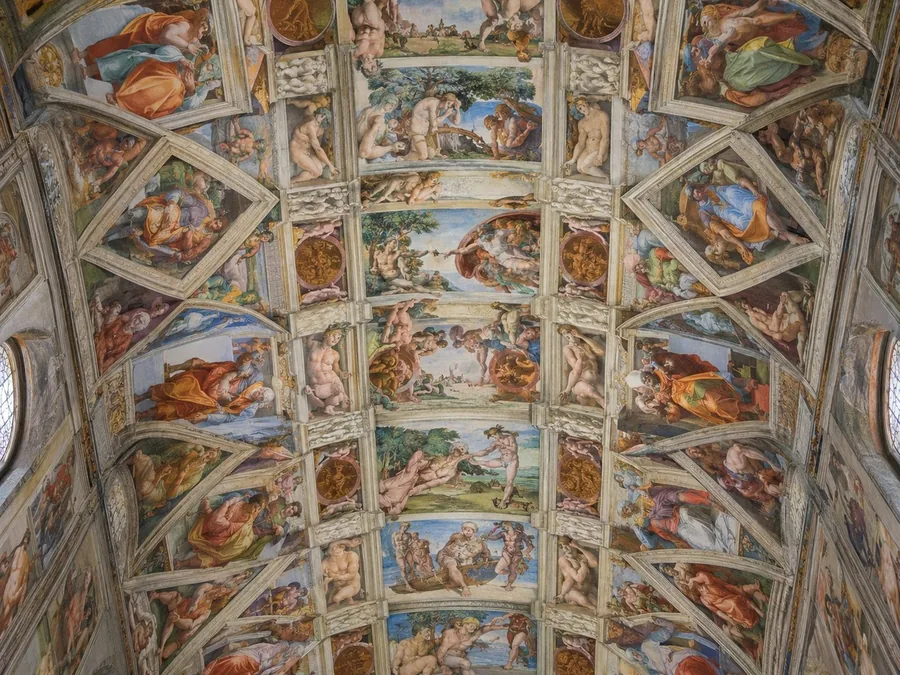
Pope Julius II commissioned the vault, and the contract is dated 8 May 1508. Michelangelo was 33 when he started and 37 when he finished in October 1512. He thought of himself as a sculptor and said so in a comic sonnet about the job. He did not paint lying on his back: he stood on a wooden bridge scaffold anchored in the walls, head bent backwards, as the sonnet describes. Down the middle run nine scenes from Genesis, from the Creation to Noah; the story starts above the altar, and the Creation of Adam is the fourth panel. Around them sit seven prophets, five sibyls and twenty seated nudes, over 300 figures in all.
The altar wall came more than twenty years later. Michelangelo painted the Last Judgment for Paul III between 1536 and 1541, from the age of 61 to 66, and it is about 13.7 by 12 m. Look for Minos, judge of the underworld, with donkey ears: Vasari says he has the face of Biagio da Cesena, the papal master of ceremonies who objected to the nudes. The flayed skin held by St Bartholomew is often read as a self-portrait, an idea first put forward in 1925 and still an interpretation. Give the side walls a minute too: Botticelli, Perugino, Ghirlandaio and Rosselli painted the lives of Moses and Christ there in 1481–1482. What to look for, wall by wall.
When to go
The museums open Monday to Saturday, 08:00 to 20:00, with last entry at 18:00. They are closed on Sundays except the last Sunday of the month, a morning opening with the longest queues of the year. Saturdays and Mondays are the busiest days; Tuesday to Thursday are calmer, and November and January to February are the quietest months. The best times are the first slots of the morning or the last hour and a half before last entry. Early entry is not magic: Jody, on an early tour, still had to “stand in line along with a LOT of other people” until the 08:00 opening. Seasonal Friday evening openings are usually offered, but check the official calendar before you go. Hours and days to avoid.
What I would tell a friend
Book a timed slot, and don’t arrive outside it. Cover your shoulders and knees, because the check that counts happens at the chapel door; a light scarf in the bag saves arguments. The dress code in detail. Go early or late, and never at midday in July. Read up or hire a guide before you go in, since nobody will explain anything once you are inside. And when you get there, stop near the wall, let the crowd move past, and look up slowly, starting above the altar, where the story begins.
Ready to book?
The timed ticket below is the plain way in; if you would rather have the ceiling explained before the silence, compare a guided tour with the ticket, and check the hours and the days to avoid and the dress code first. The live price and times are in the booking widget.
Frequently asked questions
Is there a separate ticket for the Sistine Chapel?
No. The chapel is part of the Vatican Museums and every museums ticket includes it; there is no other way in. Can you see only the chapel.
How long do you need for the Sistine Chapel?
Plan on 2 to 3 hours for the museum route and the chapel, plus the security queue. How much time you need.
Can you take photos in the Sistine Chapel?
No. Photos, filming and phones are not allowed in the chapel, and visitors must keep silent; the rest of the museums allow photos without flash. Photos and silence.