What to Look For Inside
Ticket or guided tour?There is no separate ticket for the Sistine Chapel: it is the last room of the Vatican Museums, and every ticket to the museums includes it. What you choose is a timed entry slot on your own, or a guide who walks you through the galleries and explains the ceiling before you go in, where talking is not allowed.
Compare the optionsThe ceiling, in reading order
Guards will not let you stop for long, so read this before you go in. The nine Genesis scenes run along the centre of the vault, starting over the altar with God separating light from darkness and ending towards the entrance wall with Noah. The Creation of Adam is the fourth from the altar: the two fingers that nearly touch. Most people crowd directly under it; step back towards the entrance and you see it in its row.
Along the sides, seated on painted thrones, are seven prophets (Zechariah, Joel, Isaiah, Ezekiel, Daniel, Jeremiah and Jonah) and five sibyls (Delphic, Erythraean, Cumaean, Persian and Libyan). Julius II’s original plan was twelve apostles. Between the scenes sit twenty ignudi, male nudes whose twisting bodies owe a lot to the Belvedere Torso you passed an hour earlier. The lunettes over the windows hold the ancestors of Christ, and the four corners show David and Goliath, Judith and Holofernes, the Brazen Serpent and the Punishment of Haman.
The hidden things: fact and interpretation
These are the ones people ask about, and they are not all equal.
- The Libyan Sibyl was drawn from a male model. This one is documented: a red-chalk study in the Metropolitan Museum shows a young man in her pose.
- Biagio da Cesena as Minos. Documented by Vasari. Paul III’s master of ceremonies objected to the nudes, and Michelangelo put his face on Minos, judge of the underworld, in the Last Judgment, with donkey ears and a snake biting his genitals. When Biagio complained, the pope reportedly joked that his jurisdiction did not extend to Hell; that part is an anecdote.
- The self-portrait in St Bartholomew’s flayed skin. Proposed in 1925, widely accepted, still an interpretation.
- The brain in the Creation of Adam: the idea that God’s group is shaped like a human brain dates from a 1990 medical paper. Popular, unproven. The same goes for a 2010 claim about a brain stem in God’s neck in the first scene.
- Hidden insults to the pope, kidney shapes and the like come from popular books and are not established.
The Last Judgment
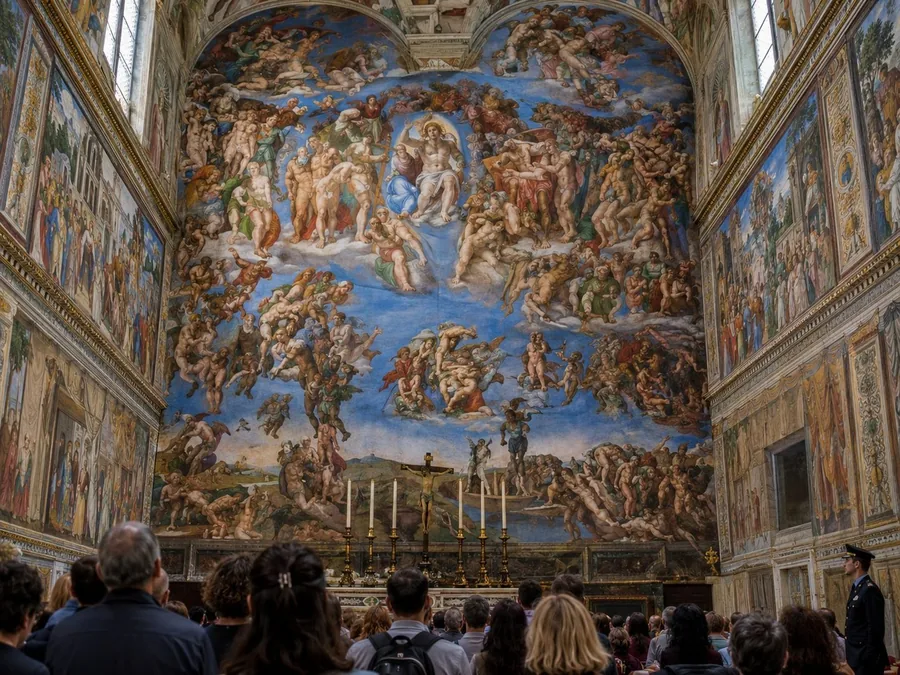
The whole altar wall, about 13.7 by 12 m, with more than 300 figures, painted from 1536 to 1541. Look for St Bartholomew holding his flayed skin and the face in it, and for Minos with his donkey ears. Many of the loincloths were added after Michelangelo’s death, by Daniele da Volterra, known ever after as “Il Braghettone”, the breeches-maker, following the church decrees of 1563 and 1564. The restoration that finished in 1994 removed later additions but kept his.
The walls most people miss
Before Michelangelo, in 1481 and 1482, Perugino, Botticelli, Ghirlandaio and Cosimo Rosselli and their workshops painted the side walls in about eleven months: the Life of Moses on one side, the Life of Christ facing it, with a row of early popes above. Botticelli’s panels are the ones I always go back to. The frescoes on the entrance wall were repainted in the late sixteenth century. How the room came together is on a short history of the chapel.
On the way: the museums’ famous pieces
The most famous piece in the Vatican Museums is the chapel ceiling, but you pass a lot before it. In the Pio Clementino, the Laocoön (found in 1506, the find traditionally counted as the museums’ beginning), the Apollo Belvedere and the Belvedere Torso. Upstairs, the Gallery of Maps, about 120 m of painted maps of Italy from the 1580s. Then the Raphael Rooms, with the School of Athens, painted in 1509 to 1511, the same years Michelangelo was on the scaffold. If you take the optional Pinacoteca detour, it holds Raphael’s Transfiguration and Leonardo’s St Jerome. At the exit, the double spiral ramp is Giuseppe Momo’s of 1932, not Bramante’s. The painter’s own story is on Michelangelo and the ceiling.
Bring small binoculars if you have them. They fit in a small bag, and the prophets’ faces are 20 m above you.
You cannot talk in the chapel (the reasons are on photos and silence), so a guide does the pointing in the rooms before it. Craig called his two-hour tour “fast paced” but said they were “able to see a lot”.
Frequently asked questions
What is the most famous picture in the Sistine Chapel?
The Creation of Adam, the fourth Genesis scene from the altar on the ceiling, painted by Michelangelo between 1508 and 1512.
What hidden things are in the Sistine Chapel?
Biagio da Cesena’s face on Minos is documented, and so is the male model behind the Libyan Sibyl. The self-portrait in St Bartholomew’s skin and the brain shape in the Creation of Adam are modern interpretations. Michelangelo’s side of the story is on Michelangelo and the ceiling.
What are some interesting facts about the Sistine Chapel?
It was built for Sixtus IV in 1473 to 1481; the ceiling has over 300 figures; Michelangelo painted it standing; the Last Judgment’s loincloths were added after his death; and the conclave still meets there. More on the history page.
What is the most famous piece in the Vatican Museums?
The Sistine Chapel ceiling. Among the sculptures, the Laocoön; among the paintings outside the chapel, Raphael’s School of Athens.
Who painted the walls of the Sistine Chapel?
Perugino, Botticelli, Ghirlandaio and Cosimo Rosselli with their workshops, in 1481 and 1482, decades before Michelangelo.